Verifying Burberry Shirt Links: Spreadsheet vs Sheets
In this note
## Defining the burberry Shirt Link Verification and Recording Task If your goal is to find burberry shirt links on [fashionreps](https://fashion-reps.net/) that can be further verified, and save the results as a maintainable record for future reference, the core is not copying the entire webpage content into a spreadsheet, but rather confirming item-by-item the product title, color, images, source entry, link status, and update time. Once completed, you should be able to distinguish candidates
Editor score 4.2 / 5
Defining the burberry Shirt Link Verification and Recording Task
If your goal is to find burberry shirt links on fashionreps that can be further verified, and save the results as a maintainable record for future reference, the core is not copying the entire webpage content into a spreadsheet, but rather confirming item-by-item the product title, color, images, source entry, link status, and update time. Once completed, you should be able to distinguish candidates for further research, pages with incomplete information, and links that are either dead or cannot be confirmed. 🔎
This article focuses solely on this task: using fashionreps' website directory for initial verification, then using Google Sheets for long-term record keeping. It is not equivalent to confirming stock, price, size fit, brand authenticity, or final purchase outcome. Orders, payment, and shipping should still be completed on the actual shopping agent's website.
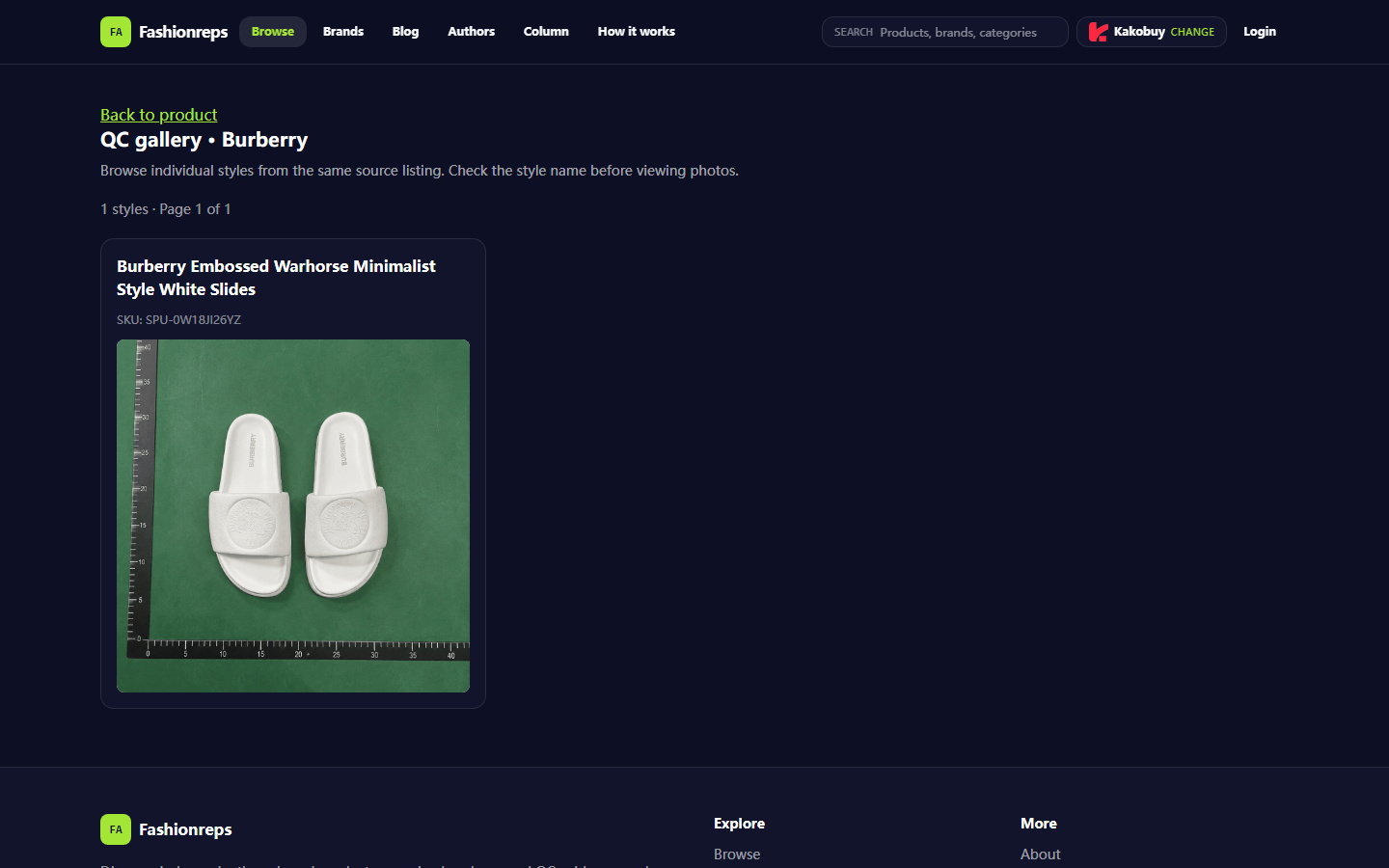
The page verification date for this session is 2026-10-11. The visible directory page includes brand browsing, on-site search, product details, QC photo entry, and a shopping agent selection entry. The currently provided Burberry QC page shows "Burberry Embossed Warhorse Minimalist Style White Slides", not a shirt. Therefore, this page cannot be considered a burberry shirt candidate, nor can price, stock, or material for shirts be inferred from it.

Caption: Use the visible product directory and QC pages on the target site as the entry point for verification, then save the confirmed fields into a personal record sheet.
Confirming Product Title, Color, and Visible Links from fashionreps' Current Directory
First, start from the site's brand entry or search function; do not fill in guesses in Google Sheets beforehand. After searching for burberry, prioritize opening specific product pages rather than only recording brand listing pages, tag pages, or search result pages.
At minimum, check the following for each candidate:
- Whether the page title clearly includes the product category, such as shirt, overshirt, or T-shirt.
- Whether the page displays color, style name, or other identifiable variants.
- Whether the page can open the complete product content, rather than a blank page, error page, or navigation-only page.
- Whether there are visible product images and whether they correspond to the title.
- Whether the page has QC photos or other physical information for verification.
- Whether the page URL is stable and opens normally after refreshing.
The currently provided QC page has only 1 Burberry style, and the page title points to white slides. If your goal is shirts, this record should be marked as "category mismatch" rather than rewritten as a shirt. The same brand does not mean the same product category; this step prevents mistakenly including shoe pages in a clothing list.
First Determine Whether the Page Is a Valid Candidate
Follow this order:
- Open the product detail page.
- Copy the full title displayed on the page.
- Record the actual visible color or variant on the page.
- Check whether the product image and QC image are of the same style.
- Return to the directory or search results to confirm that the entry can still be found.
- Save the page URL as a candidate link.
If the page only has the brand name with no clear product title or visible product information, do not mark it as a valid shirt candidate. It can be kept in a "to be supplemented" list, but the remarks must explain what is missing.
How to Open, Return, and Record Candidates in a Website Type Spreadsheet
fashionreps' website directory is suitable for discovery and initial verification. It helps you narrow down from a larger catalog through brand, search, product pages, and QC pages. The shopping agent selection entry on the page indicates that after clicking Buy or a similar purchase entry, the subsequent order process will be redirected to the selected agent's website; do not treat fashionreps' directory page as an order backend.
In a website type directory, it is recommended to adopt the rhythm of "open, verify, return, open again":
- First find candidates on the search or brand page.
- Open the product details in a new tab to avoid losing the search position.
- Verify title, color, images, and QC information.
- Return to the directory to continue checking the next candidate.
- Only write items that have completed minimal verification into the "confirmed" area.
If a page has multiple similar burberry items, do not judge solely by thumbnails. First compare titles, then colors and images; if it is impossible to confirm whether they are the same style, keep both candidates and note "style relationship unknown" in the remarks. 🧾
Recommended record fields:
| Field | What to Fill In | Recording Principle |
|---|---|---|
| Product Title | Full title visible on the page | Do not add style words not present on the page |
| Product Category | Shirt, jacket, shoes, or unknown | Judge together with page title and images |
| Color | Color clearly displayed on the page | Write "not displayed" if no color information |
| Product Link | Openable detail page URL | Do not replace with search page or brand page |
| Image Status | Image visible, missing, or inconsistent | Only record the actual page situation |
| QC Status | Has QC, no QC, or cannot confirm | Do not use ordinary product images as QC evidence |
| Verification Date | Date of this opening and checking | Facilitates tracing if link later becomes invalid |
| Remarks | Issues such as category mismatch, missing fields | Write next action, not guessed conclusions |
For this page sample, at minimum record: Product Category "shoes", Product Title "Burberry Embossed Warhorse Minimalist Style White Slides", and note in remarks "not a shirt candidate". This preserves the verification fact and avoids incorrectly expanding page information.
How Google Sheets Saves Links, Source, Update Time, and Remarks
Google Sheets is more suitable for long-term maintenance because it allows filtering by category, status, date, and issue type, and facilitates collaboration among multiple people. But it does not automatically prove that a link is valid. "Confirmed" in the sheet only means that you completed the specified page checks on the recording date; it does not mean that the item is currently in stock or definitely purchasable.
It is recommended to create a master sheet and use a limited set of status values:
- Pending verification
- Confirmed candidate
- Category mismatch
- Incomplete fields
- Link dead
- Duplicate candidate
- On hold
When filling in links, first paste the detail page URL, then check once by opening the link. Do not judge page content solely by whether the URL contains burberry, and do not directly mark brand homepages, search pages, or QC main pages as product links.
You can split the update time into two fields:
- Page verification date: the date you last actually opened and checked the page.
- Record update time: the date you last modified this row in the sheet.
The two may differ. For example, the page was verified on October 8, but remarks were added on October 11; do not combine these two dates into one field. 📅
When collaborating, it is recommended that one member is responsible for page verification and another for sheet cleanup, but each row must retain source and remarks. If multiple people work simultaneously, do not use "looks fine" as a status; specify which fields were checked and which are still missing.
Steps for Checking Product Images and Text Specifications with Both Methods
Images and text must be checked separately, then cross-compared. Text titles can indicate product category or color, but cannot automatically prove that the images are of the same model; images can show appearance, but cannot infer material, size, or stock from appearance alone.
Step 1: Check Title and Category
Confirm whether the title clearly points to a shirt. If the page title is slides, shoes, hoodie, or another category, mark it as category mismatch directly. Do not classify the item as a shirt just because the title contains Burberry.
Step 2: Check Color and Images
Look at the color in the page text, then check whether the main image and QC image show the same color. If the text says white but the image cannot be determined, the status should be "incomplete fields" rather than arbitrarily changing to white or off-white.
Step 3: Check Detail Images and QC Images
If the page provides both product images and QC images, compare whether the same patterns, pockets, collar type, buttons, or other identifiable features appear. Only describe visible differences; do not write image observations as if you have touched the material or actually tried on the item.
Step 4: Record What Cannot Be Confirmed
For size charts, fabric composition, seller information, or stock not shown on the page, do not leave it blank and let readers assume it is confirmed. Write "not shown on page" and explain in remarks that further verification with the actual shopping agent or seller is needed.
How to Mark Unknown When a Link Is Dead or Fields Are Inconsistent
When encountering a link that cannot be opened, redirects to an error page, changed product title, or images inconsistent with text, first stop completing the record and do not re-guess product information. Change the status to the corresponding issue type and retain the date of the last successful opening.
Recommended remark wording includes:
- "Link opens to an error page, pending review."
- "Title shows shoes, inconsistent with shirt task."
- "Page has product images, but no color displayed."
- "Cannot confirm if text and images are for the same variant."
- "QC page visible, but corresponding detail page not found."
"Unknown" is not a failure record but a protective state to prevent error propagation. Once the page recovers or additional evidence is provided, change it to confirmed candidate. If repeated verification still cannot confirm, keep the unknown state; do not give a definite conclusion just to fill the sheet. ⚠️
Applicable Boundaries for Real-Time Website Browsing and Long-Term Sheet Maintenance
The website directory is suitable for answering "which pages are currently available for further checking". Its advantage is direct viewing of current visible titles, images, brand categories, and QC entries. Google Sheets is suitable for answering "which candidates I have checked before, which fields are missing, which links need review". Its advantage is filtering, sorting, remarks, and collaboration, not replacing website content verification.
Do not let the two impersonate each other:
- Website pages are the source of truth; sheets are verification records.
- The shopping agent entry on the website is an entry point for subsequent processes, not proof that an order has been placed.
- The update time in the sheet is the record time, not the product inventory update time.
- QC images are verification materials provided by the page, not proof of personal purchase, receipt, or try-on.
- "Confirmed" in the sheet only means field checks are completed, not that authenticity, quality, or after-sales results are guaranteed.
If you only need to temporarily compare one or two pages, direct website browsing is sufficient; if you want to continuously collect burberry shirt candidates, collaborate with multiple people, or regularly review links, then it is worth creating a Google Sheet. For the currently provided Burberry QC page, since the visible item is white slides, the most appropriate long-term record status is "category mismatch", not "confirmed shirt candidate".
Final Action: Keep burberry Candidates with Openable Links and Complete Fields
After completing a verification pass, only keep shirt candidates that meet all of the following conditions:
- The detail page can be opened.
- The product title clearly points to a shirt or an explainable shirt category.
- Color or variant information is displayed, or explicitly marked as not displayed.
- Images and text do not have obvious conflicts.
- Product link, source page, and verification date have been recorded.
- Any unverifiable content is written in remarks, not filled in with guesses.
Keeping items that do not meet the conditions in a problem list helps with future review and prevents the same dead page from being collected repeatedly. The ultimate goal is not to increase the number of rows in the sheet, but to leave a small number of burberry shirt candidates that can be opened, traced, and have clear field boundaries. ✅
Article Image
Agent Platform Shopping FAQ
1. What categories of products can be found on repgalaxy.tips?
repgalaxy.tips offers a very rich product range, including shoes, T-shirts, sweaters, hoodies, jeans, sweatpants, shorts, beach shorts, factory clearance items, down jackets, baseball jackets, shirts, hats, jewelry, bags, electronics, sunglasses, socks, underwear, and trendy collectibles.
2. What types of products are listed in the repgalaxy.tips spreadsheet?
In the repgalaxy.tips spreadsheet, shoes, clothing, bags, accessories, jerseys, perfumes, hats, scarves, belts, and various household items are included.