Thom Browne Knitwear: Spreadsheet vs Google Sheets
In this note
When selecting [Thom Browne](https://fashion-reps.net/brand/thom-browne) knitwear for fall/winter, the common pitfall isn't usually finding candidates—it's being unable to compare them after saving: mixing up colors, scattered size information, broken product links, or conflating product page specs, QC clues, and personal judgment. This article focuses on one specific task: first find candidates in [fashionreps](https://fashion-reps.net/)' website-style product catalog, then use Google Sheets to
Editor score 4.2 / 5
When selecting Thom Browne knitwear for fall/winter, the common pitfall isn't usually finding candidates—it's being unable to compare them after saving: mixing up colors, scattered size information, broken product links, or conflating product page specs, QC clues, and personal judgment. This article focuses on one specific task: first find candidates in fashionreps' website-style product catalog, then use Google Sheets to build a reviewable fall/winter candidate list, and finally return to product pages for pre-order verification.
This method suits those who need to manage multiple colors, sizes, or fits simultaneously. It's not for people who want to buy a single item quickly, nor does it treat spreadsheet records as a guarantee of product authenticity or final quality. fashionreps pages serve as an entry point for discovery, categorization, and viewing clues; orders, payment, and logistics still need to be completed on your chosen shopping agent's website.

Defining the Task of Organizing Thom Browne Fall/Winter Knitwear Candidates
Start by writing the goal as actionable steps, not just a keyword. It's recommended to scope this task to:
- Find 2–5 Thom Browne knitwear candidates suitable for fall/winter comparison.
- Record product name, color, visible sizes, fit description, page-displayed price, and product page URL.
- Mark which information comes from the product page, which is just QC clues, and which needs confirmation from the shopping agent or seller.
- Before deciding to order, recheck whether the page still opens, whether specs have changed, and whether the images are sufficient for judgment.
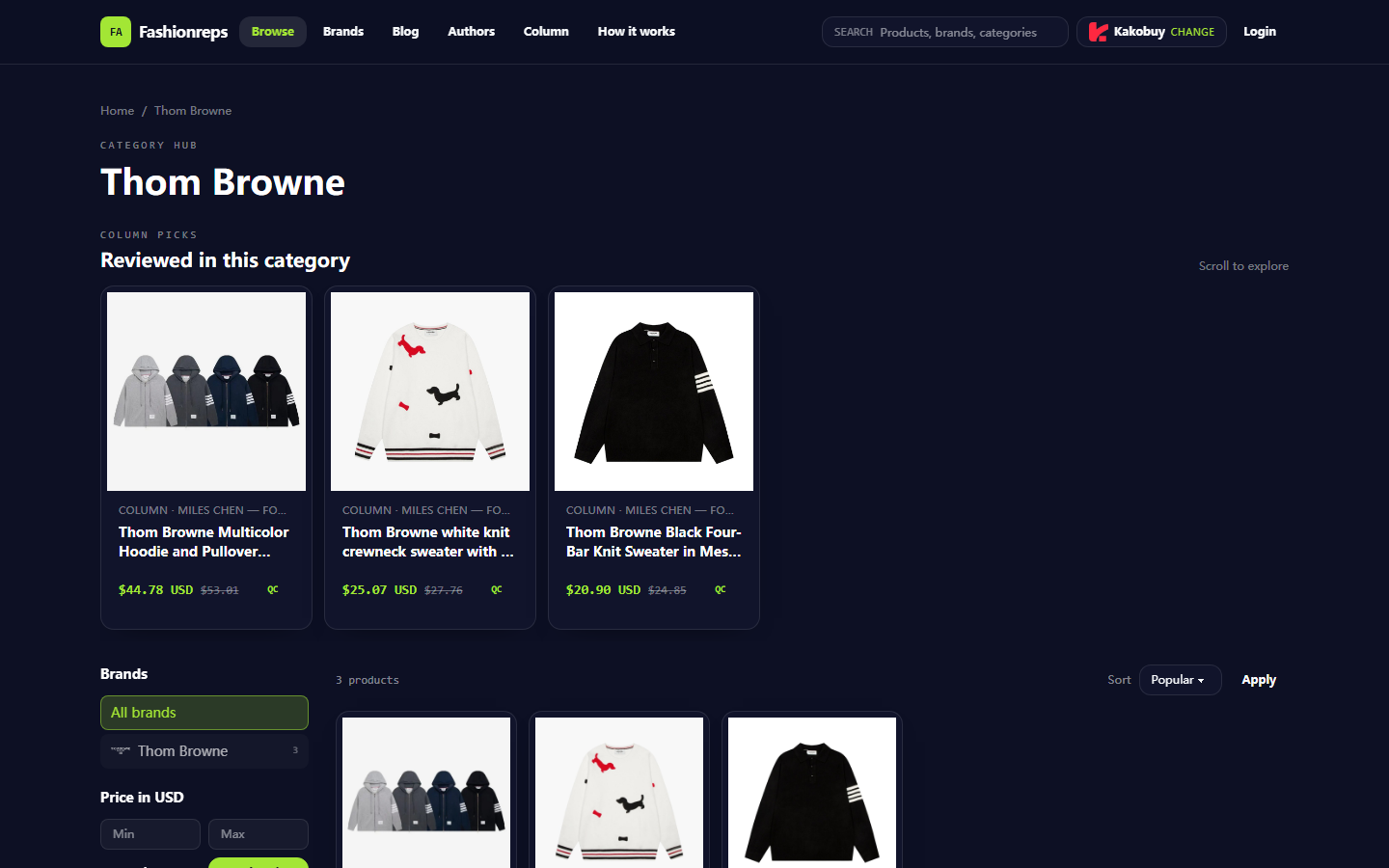
fashionreps' Thom Browne category page currently shows 3 candidate entries, including a colorful hoodie and pullover collection, a white dog-motif knit crewneck sweater, and a black Four-Bar mesh knit sweater. The page also displays some sizes, reference prices, and QC markers. These fields are suitable for building an initial list, but should not be directly interpreted as real-time inventory, final transaction prices, or quality commitments.
The reference prices visible on this page are $44.78, $25.07, and $20.90 respectively; the page also shows corresponding previous reference prices. Prices, sizes, inventory, sellers, and link statuses may change, so record the verification date when saving candidates and reopen product pages before ordering.
Browsing fashionreps' Website-Style Spreadsheet: Categories, Brand Entry, and Product Cards
The "website-style spreadsheet" here is more like a field-organized product catalog rather than a freely editable spreadsheet. Its value lies in presenting products by category, brand, and card structure, helping users transition from browsing to comparison.
From the visible page structure, the suggested usage sequence is:
- Enter the Thom Browne page from the category or brand entry.
- Browse product cards first, noting product name, reference price, visible sizes, and QC markers.
- Use price filters to narrow down, then view by popular, newest, or price order.
- Open specific product pages and record details, rather than just saving the category page.
- Continue order-related matters through the purchasing agent entry on the page.
The advantage of the category page is reducing initial search cost, especially for those who know the brand and category but haven't pinned down specific product links. It also helps users quickly discover different patterns, material expressions, and fit directions. However, card information is usually insufficient for size judgment, material confirmation, or after-sales decisions, so the category page cannot be treated as a final verification page.
QC markers on the page only indicate the existence of clues or entries related to quality verification, not that every product has passed a uniform standard inspection. When recording, place them in a separate QC clue column, and do not write conclusions like "quality verified" or "guaranteed flawless". 🔍
Using Google Sheets to Record Color, Size, Fit, and Update Time
Google Sheets is suited for the second layer of organization: putting scattered information from multiple product pages into unified fields, and preserving space for subsequent filtering, collaboration, and review. The spreadsheet should not replace product pages but help you spot missing information and conflicting records faster.
Recommended fields:
| Field | Recording Method | Main Purpose |
|---|---|---|
| Candidate ID | TBK-01, TBK-02, etc. | Prevent duplicate records |
| Product Name | Copy the visible name from the page | Preserve original identification |
| Color and Pattern | e.g., black, white, colorful, dog motif | Compare visual direction |
| Category and Fit | Crewneck, pullover, hoodie, mesh knit, etc. | Exclude unsuitable styles |
| Visible Sizes | Record the size range shown on the page | Form initial screening, not a substitute for size confirmation |
| Page Reference Price | Record currency and page date | Track changes, not treated as final price |
| Product Page Status | Openable, redirected, unopenable, needs review | Handle broken links |
| QC Clue | Yes, no, needs checking, cannot determine | Distinguish clues from conclusions |
| Last Verification Date | Use YYYY-MM-DD | Identify outdated information |
| Pre-order Action | Add actual measurements, confirm stock, etc. | Prevent missing next steps |
Color and pattern should be split into two fields. For example, "white dog motif" should not be recorded as just "white", otherwise you might miss it when filtering for patterned styles later. Fit terminology should also be consistent, e.g., record "knit crewneck sweater" as "knit crewneck", and "hoodie and pullover collection" as "hoodie & pullover collection", while keeping the original product name for cross-referencing.
For price fields, keep the numeric value, currency, and verification date, not just a context-free number. The reference price on the page may differ from the shopping agent's quote, domestic seller's actual price, shipping, service fees, or taxes, so add a separate column "final cost to be confirmed" to avoid mistaking the reference price for the settlement price.
Executing Website Browsing and Spreadsheet Filtering Around the Same Candidate
Comparison efficiency depends on the division of labor between the two tools. fashionreps is for discovery and reviewing page evidence; Google Sheets is for filtering, sorting, and recording to-do items.
Recommended cycle:
- Select a candidate on fashionreps category page and open the product details.
- Copy the product name and page URL first, then fill in color, pattern, category, and visible sizes.
- Write the page reference price and verification date into the spreadsheet.
- Mark content directly visible on the page as "product page specs".
- Mark clues from QC entries, images, or comments as "QC clues", without extending them to definite conclusions.
- Use filters to keep candidates that meet seasonal, color, and fit requirements.
- Return to candidate pages to recheck links that still open, and add pre-order actions.
For example, if the goal is to find dark-colored styles suitable for fall/winter layering, you can first filter black or dark candidates, then categorize by fit such as crewneck, hoodie, or mesh knit. Filtering results only narrow the scope; they cannot replace confirmation of size charts, fabric descriptions, and seller information.
Add a "reason for selection" field, but only write reviewable judgments, such as "color fits fall/winter outfits", "page shows M–2XL", "need to confirm thickness". Do not write "best quality", "best value", or "definitely fits" unless backed by clear, verifiable evidence. 🧶
Comparing Mobile Zoom, Image Viewing, Search, and Link Copying Experiences
The difference between the website directory and Google Sheets lies not in which is better for all scenarios, but in the problems they solve.
fashionreps is better for discovering candidates and viewing product visual information. Product cards display brand, name, reference price, and QC markers, allowing users to browse before entering specific pages. On mobile, product images and cards are suitable for quick scanning, but detail judgment may be affected by screen size, image resolution, and page layout. When you need to confirm knit texture, pattern placement, or detail workmanship, open the original product page and zoom in; don't rely solely on thumbnails.
Google Sheets is better for organizing multiple candidates side by side. When filtering by color, size range, fit, and link status, a spreadsheet is clearer than switching between multiple browser tabs. It's also good for recording multiple verification results for the same candidate, or letting multiple people add "items to confirm".
Link copying serves different purposes: links on the website are for continuing browsing and entering the purchasing agent flow; links in the spreadsheet are for building a reviewable index. After copying, test it immediately to avoid saving category pages, redirect pages, or dead addresses as product pages.
Don't describe mobile operation as a fixed speed or universal advantage. Actual experience depends on network, browser, page updates, and device screen. A more reliable judgment: website for discovery and viewing, spreadsheet for archiving and filtering, and combining them helps preserve decision evidence. 📱
Using Verification Columns to Distinguish Product Page Specs, QC Clues, and Pending Information
This is the most important boundary in the organizing process. A single candidate typically contains three types of information with different reliability:
Product page specs are content directly displayed on the page, such as product name, visible sizes, reference price, pattern, and category. When recording, try to keep the original meaning without adding material, weight, or suitable audience.
QC clues are page entries, images, or descriptions related to quality verification. They can prompt users to continue checking, but cannot automatically prove that stitching, fabric, dimensions, or details meet expectations. Especially from images alone, don't write "touched material", "actually worn", or "confirmed flawless".
Pending information is what still needs to be resolved before ordering, such as actual available sizes, length and chest measurements, inventory, seller shipping status, purchasing agent fees, shipping costs, return/exchange conditions, and destination country import requirements.
Add a "evidence type" dropdown in the spreadsheet: product page spec, QC clue, user to verify, external policy, unknown. Update the verification date whenever information changes to prevent old prices or sizes from influencing decisions.
If multiple candidates use the same image, description, or similar links, don't immediately conclude they are the same product. Return to the respective product pages, compare product names, images, specs, and page status, then decide whether to merge. A "suspected duplicate reason" column can help team members review instead of deleting records outright.
Handling Page Updates, Duplicate Candidates, and Unopenable Links: Recording Methods
Page updates are common in product catalog organization. The safest approach is not to overwrite old records but to keep a trail of changes. Use "status" and "last verification date" columns:
- Openable: product page still accessible, core fields reconfirmed.
- Content changed: page accessible, but price, size, image, or name has changed.
- Needs review: page opens normally, but key information is insufficient.
- Redirected: address jumps to another page, need to confirm if it still corresponds to the original candidate.
- Unopenable: temporarily inaccessible, don't assume the product is delisted based on this.
- Discontinued: after review, confirmed the record is not suitable for the current task.
When encountering duplicate candidates, first compare product page URLs and page content before considering merging. If the same product appears via different category entries, keep one main record and save the other entry in notes. If colors, patterns, or size sets differ, don't merge just because names are similar.
When a link won't open, record the access date and error status first, then try to relocate from the brand category page. Don't fill in new links from memory, and don't treat search result summaries as current product evidence. If still unconfirmable, move the candidate to "needs review" instead of continuing to use it for final recommendation.
When collaborating on the spreadsheet, each participant should only modify their assigned fields and keep notes. This reduces overwriting and helps later reviewers know whether a judgment comes from page specs, image observation, or manual pending items. 📝
Thom Browne Pre-Order Combined Workflow of Website and Spreadsheet
After initial organizing, follow this order for final checks:
- In the spreadsheet, filter candidates that still meet color, fit, and size initial screening criteria.
- Open fashionreps product pages one by one, confirm product names and links still correspond.
- Check for changes in page price, size, images, and QC clues.
- Mark unconfirmable fields clearly as pending; do not fill with speculation.
- Before entering the chosen shopping agent, confirm purchase, payment, shipping, warehouse inspection, and after-sales rules.
- Make decisions considering destination country declaration, taxes, import restrictions, and receiving requirements.
- Save the final candidate list and verification date for later package handling or after-sales issues.
The final choice should not be based solely on reference price. A lower page price may come with insufficient size info, limited images, uncertain inventory, or higher subsequent verification costs; more complete page information does not guarantee product quality, seller fulfillment, or destination receiving results.
If buying a single already-identified item, using the website page directly and completing necessary verification may be more efficient. If comparing multiple colors, fits, or sizes, the recording cost of Google Sheets is usually worth it, as it reduces the risk of repeatedly opening pages and making decisions from memory.
This combined approach mainly saves organizing time and repeated verification costs, not guaranteeing lower final prices. It adds the risk that the spreadsheet may hold outdated information, users may mistake reference prices for settlement prices, or misread QC clues as quality conclusions. Therefore, it suits those comparing multiple candidates, collaborating, and needing decision records; it's not for those who skip product page review, ignore size measurements, or want to replace confirmation from shopping agents, sellers, and customs with a spreadsheet.