Supreme Accessories: Verify Size, Weight & Shipping Costs
In this note
Introduction If you're planning to select [Supreme hats](https://fashion-reps.net/accessories/hats/supreme) or [other](https://fashion-reps.net/brand/other) [accessories](https://fashion-reps.net/accessories) from a fashion-reps page and have a shopping agent consolidate and ship them, the first issue isn't "is consolidation always cheaper?", but whether you can obtain verifiable product amounts, service fees, payment fees, packaging information, billable weight, and shipping cost evidence under
Editor score 4.2 / 5
Introduction
If you're planning to select Supreme hats or other accessories from a fashion-reps page and have a shopping agent consolidate and ship them, the first issue isn't "is consolidation always cheaper?", but whether you can obtain verifiable product amounts, service fees, payment fees, packaging information, billable weight, and shipping cost evidence under the same destination, same route, and similar query time. 📦
This article focuses on the consolidation scenario for Supreme adjustable cap accessories, helping you complete field verification, cost breakdown, and stop decisions before submitting the shipment. It does not provide unverified shipping cost figures; if the agent's page does not show destination, weight, volume, or route conditions, you should pause payment or shipment confirmation and gather the missing information first.

Clarify the Cost Decision and Evidence Boundary for Supreme Accessories Consolidation
The decision target here is an international shipping solution for one or more Supreme caps and other small accessories after consolidation. By the end, you should be able to do three things:
- Confirm that the product style, quantity, and visible specifications match the order.
- Record product amount, service fee, payment fee, packaging fee, international shipping cost, and exchange rate separately.
- Make an evidence-supported choice between consolidation and split shipping, or stop if information is insufficient.
This article does not apply to the following situations: the agent has changed the route or billing rules but you cannot re-query; the package contains items restricted by the destination country; the product page only has images without clear style, quantity, or packaging information; or you need to evade declaration and inspection through under-declaration, splitting orders to avoid taxes, etc. Consolidation can affect repeated first weight, volumetric weight, and single-loss risk, but it does not automatically eliminate taxes, restrictions, or after-sales responsibility. 🧾
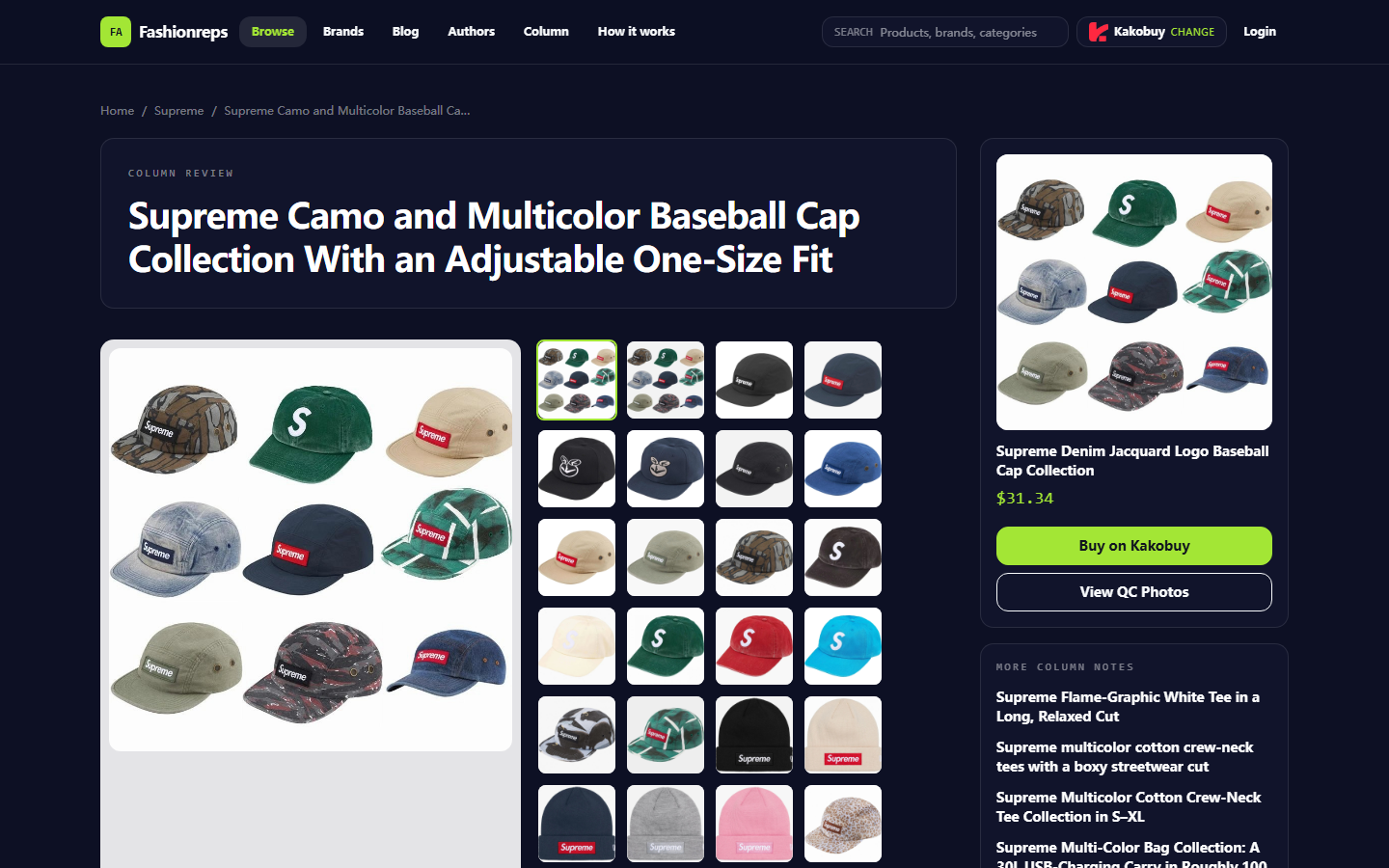
The accessory page shows that this set of Supreme caps uses an adjustable one-size form, with color options such as camouflage, leopard print, embroidered dragon, flag patterns, and various solid colors, and notes that the cap body is not suitable for folding. The page also prompts that the final product amount, service fee, and international shipping cost should be confirmed on the shopping agent's website. Thus, you cannot estimate shipping based only on the number of items; you must consider the packaging shape of the hats.
The reference product price recorded on the page is $31.34, and the page also shows a final product price including service fee of $34.19. This information corresponds to the catalog record at the time of page capture and cannot be directly considered as your current order's total paid amount, nor does it include confirmed international shipping, taxes, or destination country fees. When querying, record the page date, destination, currency, and agent name.
Confirm Accessory Style, Quantity, and Visible Specifications from the Fashion-Reps Page
First, create a separate record for each item; do not simply list "Supreme accessories" as a vague package name. At minimum, verify the following:
- Product page title and specific style.
- Color, pattern, or variant code.
- Purchase quantity.
- Whether it is adjustable, whether it is a single size, and any published size information.
- Whether the page states that it cannot be folded, needs to be laid flat, or requires extra protection.
- Whether the page provides actual stock, seller information, reference price, and an accessible purchase entry.
- Whether the style in the order matches the shopping cart and warehouse inbound photos.
For cap accessories, you cannot assume that the packaging volume is small just because the item is small. If the cap cannot be folded, flat packaging may increase the package's length, width, and height; if hard protective material is added to prevent dents, the actual volume may increase further. The general size note on the page cannot replace the seller's measurement for a specific order, so after receiving the goods, rely on the warehouse's actual measurements.
If multiple items are of different colors or patterns, record each one separately, not just a total quantity. This way, if there are warehouse photo issues, missing items, wrong styles, or after-sales disputes, you can identify which item has the problem. 🔍
Record Product Amount, Service Fee, Payment Fee, and Exchange Rate Basis
The first step in fee verification is to separate the product amount itself from the fees generated by the agent's process. It is recommended to use the following recording method:
| Fee Field | What to Record | What to Do If Missing |
|---|---|---|
| Product Amount | Specific style, quantity, original currency amount, page or order time | Do not substitute with search summaries or old page prices |
| Service Fee | Agent's service fee, calculation method, and applicable orders | Confirm whether it is calculated per item, per order, or per payment amount |
| Payment Fee | Payment channel, fixed or percentage fee, settlement currency | Do not assume it is zero if not shown |
| Exchange Rate | Exchange rate used for the order, conversion time, and base currency | Keep the original currency amount, not just the converted result |
| International Shipping Cost | Destination, route, billable weight, query time, and quote validity conditions | Pause final comparison if information is incomplete |
| Taxes and Destination Country Fees | Whether prepaid, who collects, applicable conditions | Do not interpret "not shown" as "does not exist" |
The sample on this page only supports recording the reference product price of $31.34 and the page amount including service fee of $34.19 from the catalog; it cannot be used to derive your order total. If you purchase multiple items, choose different variants, use discounts, or change agents, you must re-read the order settlement page.
When comparing exchange rates, maintain consistent basis. For example, if one set of fees is in USD and another in CNY, record the conversion time and source. Do not convert the product price at one exchange rate and the international shipping at another undated exchange rate, then use the result to judge whether consolidation saves money. 💱
Check Volume, Weight, and Billing Method Against Packaging Options
Before warehouse consolidation, request the actual data for each single item and the consolidated package from the agent. At minimum, include:
- Length, width, and height of each package before consolidation.
- Actual weight of each package before consolidation.
- Outer box length, width, height, and actual weight after consolidation.
- Whether original packaging, shoe boxes, cartons, tags, or protective materials are removed.
- Whether additional crush-proof, reinforcement, moisture-proof, or hard protection is added.
- Whether the route uses actual weight, volumetric weight, or the higher of the two.
- Volumetric weight calculation formula, units, and rounding rules.
- Minimum billable weight, additional weight unit, and any possible remote area fees.
Do not only look at the "weight" field on the warehouse page. For hats that cannot be folded, volumetric weight may affect the quote more than actual weight; but if the packaging is compact, actual weight may be the billing basis. Only after obtaining the route rules and the consolidated box's three-side dimensions can you determine which one actually applies.
If the agent only shows "estimated weight", mark it clearly as an estimate. Estimated weight does not equal the final billable weight at shipment, especially after removing packaging, repacking, or changing protection. Always obtain updated data after consolidation; do not use the weight from the single item's inbound record.
Verify Official Shipping Cost Conditions Under the Same Destination and Route
Shipping cost comparison must fix the following conditions:
- Destination country and region, precise to state, province, or postal code if necessary.
- Currency of charge.
- Route name and service level.
- Query time and quote validity.
- Number of packages.
- Consolidated box length, width, height, actual weight, and billable weight.
- Whether fuel surcharges, remote area fees, insurance, or other surcharges are included.
- Whether taxes are included or only transportation service.
The product page information currently provided does not give your destination, consolidated dimensions, billable weight, specific route, or current shipping quote, so it cannot generate a reliable international shipping cost. The correct approach is to enter the shopping agent's settlement or shipping query page and query the consolidation plan and split plan separately with the same destination and route, then save the results.
When comparing, use total cost, not just the most prominent first weight price on the page. A verifiable calculation framework is:
Consolidation total cost = product amount + service fee + payment fee + packaging fee + international shipping cost + clearly applicable taxes and destination country fees
Split total cost = product amount + service fee + payment fee + packaging fee for each package + international shipping cost for each package + clearly applicable taxes and destination country fees
If a certain item is not shown in both plans, mark it as unknown, not zero. Only when the unknown item will not change the decision, or the agent explicitly states in writing that the fee is not charged, can you continue the comparison. 🚚
Actual Fields Needed to Compare Consolidation and Split Shipping
Consolidation is not necessarily cheaper. It may reduce repeated first weight or some operational costs, but it may also increase total cost due to volumetric weight, package declared value, route restrictions, and single-loss risk. Split shipping may increase fixed fees, but it may be more suitable for route restrictions, size limits, or risk isolation.
| Comparison Item | Consolidation Needs Confirmation | Split Shipping Needs Confirmation |
|---|---|---|
| Number of Packages | How many packages actually generated after consolidation | How many items in each package |
| Billing Basis | Actual weight, volumetric weight, and higher-of rule after consolidation | Each package's billable weight and higher-of rule |
| Packaging Method | Whether laid flat, reinforced, original packaging removed | Whether each package can use a smaller outer box |
| Route Restrictions | Whether consolidated size, value, and category are accepted by the route | Whether each split package meets route restrictions |
| Loss Impact | One loss or damage may affect more items | Risk spread, but may increase fixed shipping costs |
| After-sales Handling | Need to verify all items arrive intact in one box | Need to track and handle multiple packages separately |
| Total Cost | Include all packaging and surcharges | Include fixed fees and surcharges for each package |
If the shipping cost saved by consolidation is less than the increased packaging fee, volumetric billing increase, or potential risk cost, it cannot be called savings. If consolidation only reduces one package number but makes all items share one transport loss risk, include that risk in the decision record.
Consolidation is more suitable when: the number of items is small, the consolidated dimensions do not trigger a higher billing tier, the route allows the combination, the packaging protection plan is clear, and you can accept the risk of all items being delayed or lost together. Split shipping is more suitable when: the cap needs to be laid flat, consolidation significantly enlarges the outer box, different items are suited to different routes, or package value and declaration requirements need to be handled separately.
Stop Conditions When Shipping, Tax, or Packaging Information Is Missing
Stop final payment or shipment confirmation if any of the following occurs:
- No destination and postal code, but you are asked to confirm a shipping plan.
- Only estimated weight, no consolidated three-side dimensions.
- No explanation of whether actual weight or volumetric weight is used.
- Route page does not specify rounding, minimum billable weight, or surcharge rules.
- Agent combines product amount, service fee, and international shipping cost, making total verification impossible.
- Page price differs from order settlement amount, but the difference is not explained.
- No warehouse photos after consolidation to confirm whether the cap is crushed or the style is correct.
- Taxes, import restrictions, or destination country fees are not explained with applicable conditions.
- Need to reduce costs through under-declaration, splitting to avoid taxes, or evading inspection.
- Orders, labels, or screenshots contain unmasked name, address, phone, order number, or payment information.
Stopping does not mean there is definitely a problem with the order; it only means current evidence is insufficient to support an auditable cost decision. You can ask the agent to provide additional quote details, packaging dimensions, route rules, and declaration instructions, then re-compare. Do not skip these fields because of countdowns, discounts, or stock alerts.
Final Verification Checklist Before Shipping Supreme Accessories
Before shipping, confirm item by item:
- Style, color, pattern, and quantity match the order.
- Page title and warehouse physical photos correspond to the same product.
- Whether the cap needs to be laid flat, and whether protective materials will increase volume.
- Actual weight records exist before and after consolidation.
- Outer box length, width, and height after consolidation are recorded.
- Route clearly states the billing relationship between actual weight and volumetric weight.
- Destination, postal code, route, currency, and query time are consistent.
- Product amount, service fee, payment fee, packaging fee, and international shipping cost are displayed separately.
- The page reference product price of $31.34 and page amount including service fee of $34.19 are only used as page records and not mistaken for the current order total.
- Taxes and destination country fees are confirmed as included or not.
- Consolidation and split shipping are compared using the same basis.
- Personal information is masked in saved or shared screenshots.
The final decision should be written as a verifiable record, for example: "Under the same destination, route, and query time, the consolidated plan's billable weight is the agent's final confirmed value, and the split plans are calculated according to their respective billing rules; the consolidation saving amount is the difference between the two total costs, and the new risk is that all items share one transport risk; if route restrictions, dimensions, or tax conditions change, requery." Do not fill in a specific saving amount without an actual quote.
Consolidation is only appropriate when the confirmed total cost is lower than split shipping, the packaging will not cause unacceptable crush damage, the route accepts the package conditions, and you can bear the concentrated transport risk. If shipping, volume, billing rules, or tax information is missing, it is better to delay shipment than to use guesswork instead of evidence.
Agent Platform Shopping FAQ
1. What should new users of yupoo.tips pay special attention to?
Users who first use a Taobao agent through a spreadsheet generally receive a new customer shipping discount package, and should also consult the step-by-step shopping manual for beginners.