Mammut Jacket Lists: Spreadsheet vs Google Sheets
In this note
🧥 When choosing a mammut jacket, the real challenge often isn't finding candidates—it's organizing them into a list you can review, compare, and act on. fashion-reps' website-style Spreadsheet is better for browsing the catalog, viewing image previews, and opening product pages; Google Sheets is better for creating personal fields, filter conditions, collaborative notes, and review statuses. They're not interchangeable tools, but rather organizational methods suited to different stages. This ar
Editor score 4.2 / 5
🧥 When choosing a mammut jacket, the real challenge often isn't finding candidates—it's organizing them into a list you can review, compare, and act on. fashion-reps' website-style Spreadsheet is better for browsing the catalog, viewing image previews, and opening product pages; Google Sheets is better for creating personal fields, filter conditions, collaborative notes, and review statuses. They're not interchangeable tools, but rather organizational methods suited to different stages.
This article focuses on one specific task: after you've spotted mammut jacket candidates on fashion-reps, how to organize them into a list you can continue verifying. It distinguishes between product facts directly visible on the site page, QC clues that might inform further judgment, and unverified price, stock, and size information. Until you open the product detail page or obtain the latest seller information, don't treat a candidate list as a final purchasing decision.

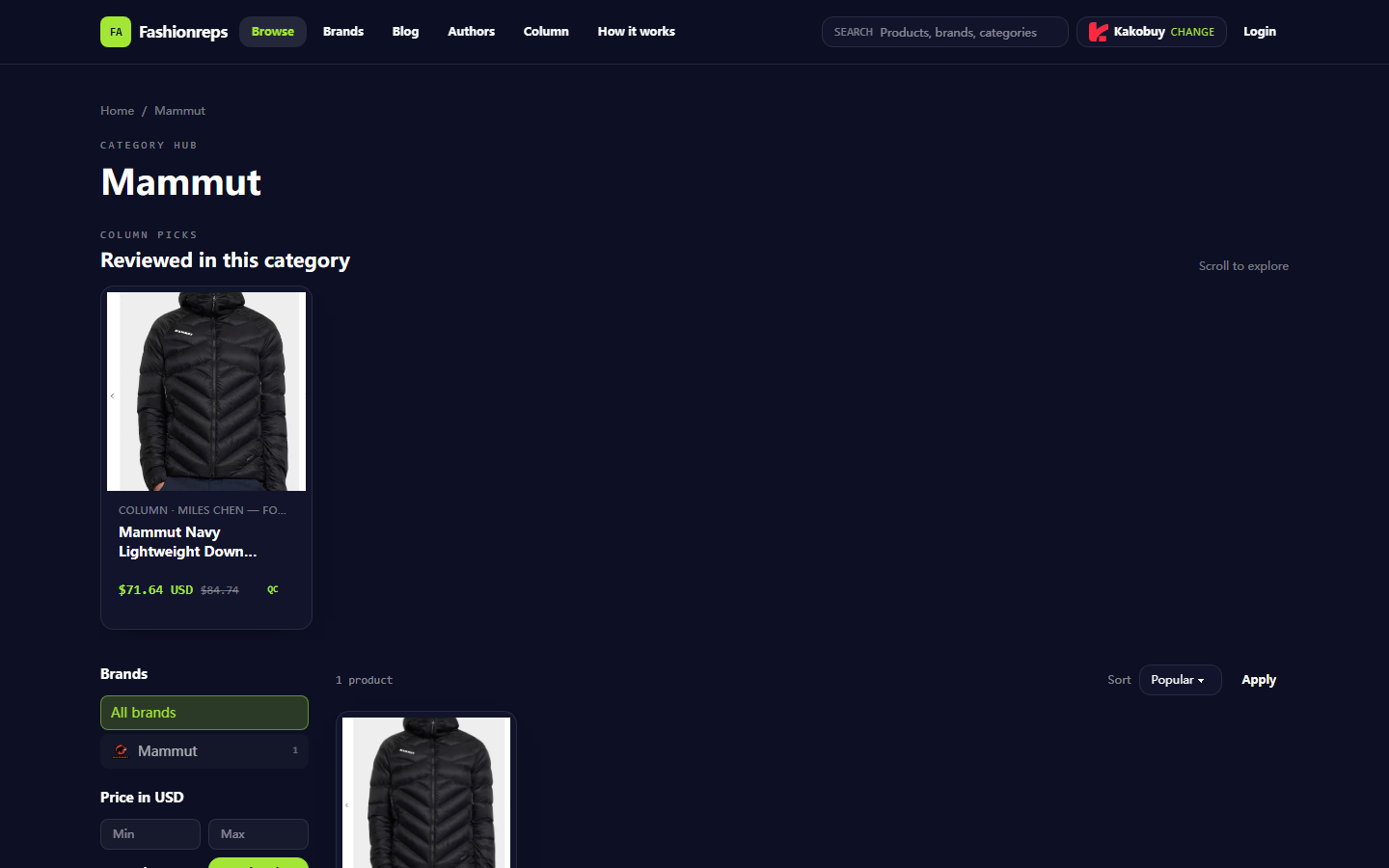
Caption: An illustration of fashion-reps' mammut jacket category page. The image is for explaining catalog navigation and candidate discovery, and does not represent real-time stock, price, or product status commitments.
Clarifying the task and evidence boundaries for organizing mammut jacket candidates
Before organizing candidates, write down the problem you're solving: are you looking for mammut jackets suitable for further review in a short time, or building a list for long-term comparison, collaborative review, and pre-order preparation? The former relies more on efficient browsing of the site catalog, while the latter requires additional spreadsheet fields and status management.
The actionable result of this step should be: each candidate has a record that links back to the original page, and can distinguish style, color, size information, images, reference price, and next verification steps. If a candidate has only a blurry image or an unconfirmed name, mark it as "needs verification" rather than adding it directly to a "purchasable" list.
Three types of information need to be distinguished:
- Product page facts: the currently displayed name, images, seller information, visible reference price, product link, and page status.
- QC clues: quality check images, detail photos, or verification notes explicitly shown on the page or related content. QC clues can only help you decide whether to continue investigating—they are not automatically equivalent to independent authentication.
- Unverified information: real-time stock, actual transaction price, available sizes, shipping costs, taxes, return/exchange conditions, and final shipping status. These should be re-verified before selecting a shopping agent and placing an order.
fashion-reps pages serve as entry points for product discovery and comparison. The Buy button on the page redirects to the corresponding agent website based on your selected shopping agent, and orders, payments, and logistics are handled by the agent platform. Therefore, having an organized candidate list does not mean the purchase process is complete. 🧾
Verifying the jacket category and visible fields in fashionreps' website-style Spreadsheet
The currently visible mammut category page includes brand navigation, category paths, filter entries, price range filters, sorting options, and product cards. The page also shows the number of items in the category and provides sorting options by popularity, newest, price low-to-high, or high-to-low. For quick candidate discovery, this page structure is more direct than creating a new blank spreadsheet, because products are already organized according to the site catalog.
At the product card level, key elements you can directly see usually include product name, reference price, previous reference price, image preview, and QC entry. An example card shows "Mammut Navy Lightweight Down Midlayer," with a reference price of 71.64 USD and a previous reference price of 84.74 USD. These prices should be treated as reference information currently visible on the page; you must record the verification date and not treat them as a long-term fixed price or final payment amount.
Page navigation is useful for answering three initial questions:
- Does this candidate belong to the mammut jacket category?
- Are the product name and image sufficient to identify the style direction?
- Is it worth entering the detail page to further check links, sizes, seller, and QC information?
The advantage of the website-style Spreadsheet is that candidates are already placed in a catalog context. You can enter the category from the brand entry, use filters and sorting to narrow down, and quickly skip styles that clearly don't meet your needs via image previews. Its limitation is equally obvious: fields not shown on the page card should not be filled in by speculation; if you need to record chest measurements, personal fit judgments, different agent quotes, or team review comments, you still need to create a separate record.
Using Google Sheets to create columns for style, color, size, and links
When you have more than two or three candidates, or need to compare repeatedly, it's recommended to create a one-row-per-candidate structure in Google Sheets. Minimal fields can start with the following columns:
- Candidate ID: use a stable ID to avoid losing track if the product name changes.
- Product Name: copy the currently visible name from the page, preserving original capitalization.
- Brand: enter mammut; if the brand field on the page is unclear, mark as "to confirm."
- Category: for example, lightweight down layer, mid-layer jacket, or another category explicitly shown on the page—do not judge based solely on appearance.
- Color: color explicitly written on the page; if image color and text are inconsistent, mark as "needs verification."
- Size: first record the size range visible on the page; if missing, do not infer stock from common sizes.
- Reference Price: include currency and verification date, e.g., USD, 2026-10-11.
- Image or Detail Page Status: record whether the detail page has been opened and whether clear images are available.
- QC Status: not viewed, clues viewed, needs further verification—do not directly write "passed."
- Product Link: save the link needed to return to the original product page.
- Agent and Order Status: no agent selected, pending quote, pending confirmation, submitted, or cancelled.
- Notes: record doubts, comparison reasons, and next steps.
If this is just personal initial screening, you don't need to create too many fields at once. Start with name, color, size, reference price, link, and next steps, then add columns as needed based on actual comparison needs. More fields mean higher maintenance costs; but for lists that require multi-person review, status columns and evidence dates are usually more valuable than decorative categorization.
Google Sheets' filter views can help you view only a certain color, a size range, or a particular review status. Freezing the header row makes long tables easier to browse, and data validation can limit QC status and order status to fixed options, avoiding multiple variations of the same status. For collaboration, comments and revision history can preserve who raised questions, who added information, and when changes were made.
The key to a spreadsheet is not moving all information into it, but making the next action clear. For example, "cheap price" is not a sufficient note; "reference price is low, but detail page not opened yet—first confirm the seller's size chart" is an actionable record. 📋
Item-by-item comparison of the same mammut candidate on site cards vs spreadsheet rows
Site cards are good for discovering candidates; Google Sheets is good for turning candidates into trackable records. Between the two, you shouldn't just copy titles—also preserve evidence levels and to-do items.
| Comparison Item | fashion-reps Website-style Spreadsheet | Organization Method in Google Sheets |
|---|---|---|
| Candidate Discovery | Quickly browse via brand category, images, sorting, and price filters | Record discovered candidates for later filtering and review |
| Product Name | Read the currently visible title on the page | Save as-is, and add internal abbreviation or ID if needed |
| Price | View reference price and historical reference price shown on page | Save currency, verification date, and "reference price" label |
| Images | Use card preview or page images to decide if worth further viewing | Save image status and details to re-check; don't treat images as material proof |
| Size and Color | Check actual information provided on the detail page | Record in separate columns, and mark missing or conflicting items as "needs verification" |
| QC | View visible QC clues from page entry | Record viewing status and specific doubts; don't write as quality assurance |
| Purchase Action | Enter external shopping agent process based on agent selected on page | Record agent, confirmation items, and order stage |
For example, a site card lets you quickly identify a dark lightweight jacket and see the current reference price; Google Sheets can then record "color name to confirm," "size chart not verified on detail page," "need to compare weight or fit with another candidate," etc. The value here is not creating a more complex table, but avoiding the situation where you reopen a page and forget what you've already confirmed.
If the product name, images, or prices shown on the site page change, the spreadsheet should keep the verification date of the old record and explain the reason for the update in the notes. Don't silently overwrite key facts, otherwise later collaborators can't tell which page view the information came from.
Comparing image previews, filtering, link copying, and note-taking methods
The order of using the site page versus Google Sheets depends on your organizing goal.
For quick discovery, the site page is more suitable. You can start from the mammut category, observe image previews and product names, then use price range or sorting to narrow down. At this stage, you don't need to copy every result into the spreadsheet; only record candidates that meet basic criteria to reduce useless data.
For multi-condition comparison, Google Sheets is more suitable. Site filters typically revolve around fields already provided on the page, while a personal list may also include color preferences, target size, layering purpose, confirmed details, and risk notes. The site helps you find candidates; the spreadsheet helps you explain why you keep or eliminate a candidate.
When copying links, save the address that returns to the original product page, and check whether it still displays a clear product name and valid content when opened. If the link redirects to an empty page, tag page, or an address that can't confirm the product, mark it as "link to fix." Don't assume a product page is valid just because there's a URL in the browser address bar.
Image records should also be restrained. Card images are suitable for judging color direction, silhouette, and obvious display information, but cannot alone confirm fill material, fabric composition, waterproof rating, warmth performance, or actual size. If images only show model shots or distant views, note that detail photos or the seller's size chart still need to be viewed.
If team members need to review, you can add a separate column for "pending questions" instead of burying doubts in long notes. For example:
- Does the detail page have a clear size chart?
- Does the color name in the image match the text?
- Is the reference price shown on the page still valid?
- Are there viewable QC images or descriptions?
- After selecting a shopping agent, does the Buy button redirect correctly?
This recording method turns a subjective impression of "looks good" into a list of next-step checks. 🔎
Distinguishing between product page facts, QC clues, and unverified stock or prices
When organizing jacket candidates, the most common confusion is between page evidence and purchase conclusions. A product page displaying a name does not mean brand identity has been independently verified; a page displaying a reference price does not mean the price will be the same at payment; a page having a QC entry does not mean all items have passed quality checks.
You can use the following judgment order:
Step 1: Confirm the page is still accessible and has a clear product name and sufficient visible information. Redirects, 404s, blank pages, pure tag pages, or pages where the product cannot be identified should not be saved as valid product pages.
Step 2: Record the facts shown on the page at that time, including name, images, reference price, previous reference price, visible color and size information. Each piece of highly volatile information should include a verification date and indicate the currency.
Step 3: Separately list items that need external confirmation as to-dos. Stock, final selling price, sizes the seller can actually ship, shipping costs, taxes, return/exchange rules, and logistics routes all need to be re-confirmed through the shopping agent or seller process.
Step 4: Interpret QC cautiously. QC images can help spot issues in stitching, branding, dimensions, or details, but they only represent the scope of visible evidence. Problems that can't be seen cannot be written off as non-existent, and images cannot replace fabric testing, actual size measurement, or after-sales commitments.
Step 5: Form a pre-order conclusion. Only when the product link is valid, the style meets your needs, key size information is clear, price and agent terms have been re-checked, and the user accepts remaining risks, should a candidate move to the next stage.
For the example reference price of 71.64 USD shown on the page, it should be recorded as a reference value at the time of page verification, not a promise of final cost. Actual expenses may also include agent service fees, domestic forwarding, international shipping, taxes, or other order fees. If the destination country has import restrictions or declaration requirements, comply with local regulations, and do not reduce apparent costs through under-declaration, splitting orders to evade taxes, or avoiding inspections.
Use cases for quick discovery, long-term organization, and collaborative review
If your goal is to quickly find a small number of mammut jacket candidates, prioritize using fashion-reps pages for brand entry, image preview, sorting, and initial filtering, then only put truly worth-further-review items into Google Sheets. This reduces spreadsheet maintenance and avoids turning a large number of irrelevant products into a long-term burden.
If your goal is long-term comparison of multiple styles, Google Sheets is more suitable as the main list. You can keep the first verification date, most recent verification date, candidate status, personal needs, and link validity, and update records when prices, sizes, or images change. For people who buy repeatedly or need to wait for additional information, this historical record is more useful than one-time browsing results.
If multi-person collaboration is needed, it's recommended to use the site page as the common factual entry point and Google Sheets as the task and review layer. One person handles initial screening and link saving, another checks sizes and images, and finally the actual orderer confirms agent, fees, and after-sales conditions. Each person only modifies their assigned fields, and leaves comments or explanations when there are disputes, to avoid multiple people overwriting the same conclusion simultaneously.
If you only want to compare prices, copying reference prices alone is not enough. You also need to record the currency, page date, whether it's a historical reference price, whether agent fees are included, and whether it was re-confirmed at final purchase. If you only want to compare appearance, don't use product images to infer material or wearing effect.
Combined verification checklist and next steps before ordering mammut jacket candidates
After completing initial organization, you can proceed in the following order:
- From fashion-reps' mammut category, confirm candidates still belong to the target category, and open each candidate's detail page.
- In Google Sheets, save the visible name, color, size, reference price, link, and verification date.
- For images, size charts, and QC clues, record confirmed content and unresolved issues separately.
- After selecting a shopping agent, check if the Buy button enters the corresponding agent process, and re-confirm the product, price, and available sizes.
- Calculate estimated product amount, agent fees, domestic forwarding, international shipping, and possible taxes—do not treat the page reference price as total cost.
- Check import restrictions, declaration requirements, and after-sales conditions of the destination country, and maintain the security of order, payment, and logistics information.
- Only after key facts have been re-verified, change the status from "candidate" to "ready to order" or "submitted."
Regarding whether to combine orders, don't draw conclusions directly from single-item reference prices. Combining packages may reduce repeated first-weight or some operational costs, but may also increase volumetric weight, package declared value, and single-loss risk; splitting packages may increase fixed fees, but might be more suitable for route restrictions, value control, or different arrival times. The final decision should be based on product quantity, packaging volume, destination country rules, insurance conditions, and agent quotes.
You can add a column "combination plan" in the spreadsheet to record estimated amounts and risks for individual shipping, combined shipping, and deferred purchase. Savings should be written as specific differences, and increased risks should be explicit, e.g., "expected to save one repeated operational fee, but one package carrying three items increases single-loss exposure." It's not advisable to claim combining is always more cost-effective without actual weight, fees, and route information.
This method is best suited for those who need to discover candidates first, then compare long-term and preserve review traces. People who only want to casually browse one or two jackets don't need to build a full collaborative sheet; but those who need multi-person filtering, waiting for size or price confirmation, should prioritize maintaining status and evidence dates in Google Sheets. Regardless of the tool used, always return to the current product page and shopping agent process for verification before final ordering, because products, prices, stock, sizes, fees, and link statuses can all change.